


Industry 4.0 In Agriculture Industry
INTRODUCTION
The agricultural sector is currently undergoing a revolutionary transformation driven by Industry 4.0. The combination of advanced digital technologies with traditional farming practices is reshaping how crops are grown, managed, and distributed, leading to significant improvements in efficiency, sustainability, and productivity. With the integration of Internet of Things (IoT) devices, drones, and satellite imaging, farmers can now collect vast amounts of real-time data on soil conditions, weather patterns, and crop health. This data-driven approach enables precise decision-making, allowing farmers to optimize irrigation schedules, fertilization regimes, and pest management strategies with unparalleled accuracy. By leveraging data analytics and automation, farmers can minimize resource wastage and environmental impact. For instance, smart irrigation systems deliver water precisely where and when it is needed, conserving water resources and reducing runoff. Similarly, the precise application of fertilizers and pesticides minimizes chemical usage, mitigating soil degradation and water pollution.
The emergence of big data analytics and machine learning algorithms has given farmers the power to make informed, data-driven decisions. By analyzing vast datasets that include market trends, consumer preferences, and agronomic insights, farmers can predict demand, optimize planting schedules, and mitigate risks. This predictive capability not only enhances productivity and profitability but also ensures greater resilience in the face of climate change and market volatility.
The adoption of Industry 4.0 has brought automation and robotics to the agricultural sector. This development has improved the efficiency of labor by automating tasks that were previously arduous and time-consuming, such as planting, harvesting, and monitoring. This has led to the freeing up of labor for more skilled and strategic roles, which has not only addressed labor shortages but also improved job satisfaction and safety for agricultural workers.
USE CASES
SMART IRRIGATION :
With the Internet of Things, farmers are able to monitor the level of water, and it also helps in analyzing the condition of soil, such as soil pH level and soil nutrients. These systems are able to adjust irrigation schedules.
DISEASE AND PEST MANAGEMENT:
With the help of predictive analytics, farmers are able to forecast crop diseases. This can help mitigate risks so they can reduce crop loss. By analyzing historical data, farmers can predict weather conditions, which gives them ideas for crop management.
CROP MONITORING:
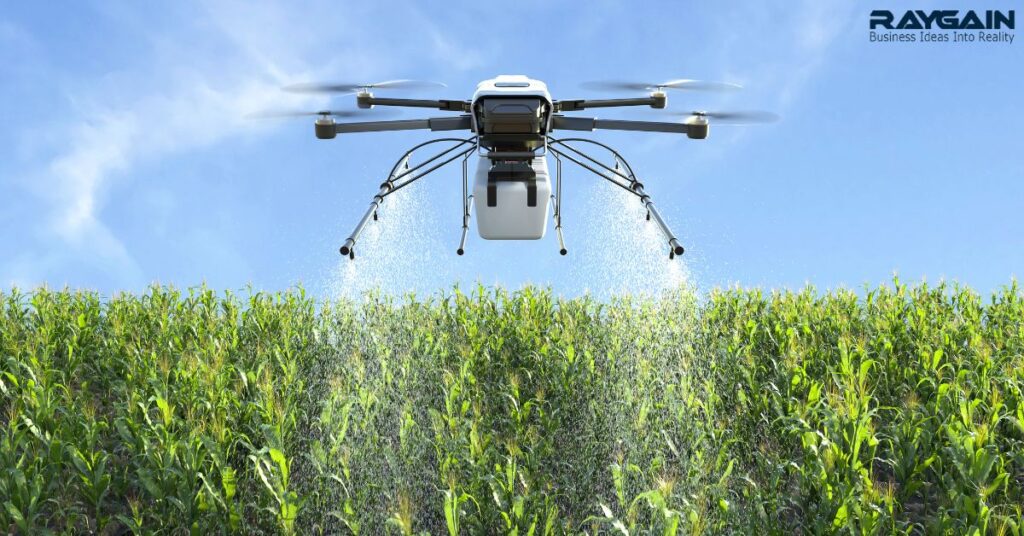
Using drones, satellites, and sensors, farmers are able to monitor crops. They can also collect data on pest infestations, crop health, and crop growth.
LIVESTOCK MANAGEMENT:
It is used to improve overall animal welfare, as through IOT and Sensors, farmers are able to monitor their animals’ health, feeding patterns, and environmental issues. It will be possible to monitor their livestock health at an early stage.
PRECISION FARMING:
Precision farming involves the precise management of agricultural inputs. It is an approach that utilizes data-driven insights and technology to optimize crop yields while minimizing inputs such as water, fertilizer, and pesticides.
VERTICAL FARMING:
Crops are cultivated in stack layers and in a controlled environment. In this environment, crops are grown under artificial lights, and environmental factors like temperature and humidity can be controlled.
BENEFITS
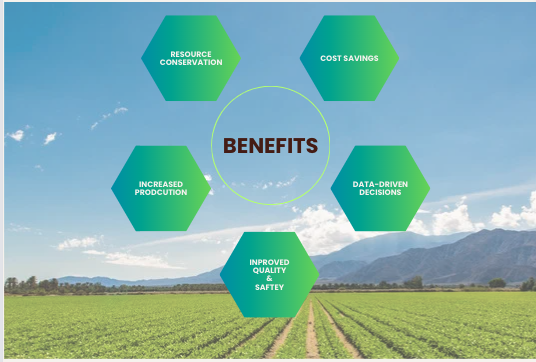
The use of advanced technologies helps reduce costs, as automated systems and precision farming can help us reduce labor and pesticide expenses. Farmers can monitor their crops’ health in real-time, which helps them make decisions about where and when to use irrigation and fertilizers. This leads to healthier crops and yields.
1. Increased Production: By precisely applying inputs such as water, fertilizers, and pesticides, farmers can ensure optimal growing conditions for crops, resulting in better harvests.
2. Resource Conservation: Through precision irrigation optimized energy consumption through automated systems. As a result, smart agriculture promotes environmental sustainability and the conservation of natural resources.
3. Cost Savings: Smart agriculture helps farmers lower operational costs by optimizing inputs and reducing waste. Automation and data-driven decision-making also streamline farming processes, saving time and labor costs.
4. Improved Quality and Safety: By closely monitoring crop health, farmers can identify and address issues early, ensuring higher-quality produce. Moreover, they can track production processes and implement food safety measures.
5. Data-Driven Decision-Making: By analyzing historical and real-time data, farmers can identify trends, predict outcomes, and optimize management strategies. This enables continuous improvement and adaptation to changing environmental conditions and market dynamics.
REAL-WORLD EXAMPLES
Yara International: Yara’s digital farming platform, Atfarm, utilizes satellite imagery and agronomic insights to provide variable rate fertilization recommendations, enabling farmers to optimize nutrient application and increase efficiency.
Bayer AG: Bayer provides digital farming solutions through its Climate Corporation subsidiary, offering tools like FieldView for collecting and analyzing field data, optimizing inputs, and maximizing crop yields.
AGCO Corporation: AGCO offers smart farming technologies under brands like Massey Ferguson and Fendt. These include precision planting and application equipment, advanced telemetry systems, and farm management software for data-driven decision-making.
CONCLUSION
Raygain is committed to supporting the agricultural industry in adopting Industry 4.0 technologies. Our goal is to enable farmers to integrate advanced technologies seamlessly into their farming operations, empowering them to improve their livelihoods and contribute to global food security and sustainability. By embracing Agriculture 4.0, we can pave the way for a resilient, efficient, and sustainable future for agriculture. Industry 4.0 is a paradigm shift in the agricultural industry, bringing in precision, efficiency, and sustainability. By leveraging digital technologies, farmers can optimize the use of resources, make data-driven decisions, and ensure the safety and quality of agricultural products. As we continue to adopt the principles of Industry 4.0, the agricultural sector is poised to meet future challenges while contributing to global food security and sustainable development.
REFERENCES
https://run.unl.pt/bitstream/10362/134682/1/agronomy_11_00667.pdf
OUR RECENT POSTS
- The Rise of AI Chatbot Development Company
- The Future Trends of Data Science and Artificial Intelligence: Shaping Tomorrow’s World
- Staff Augmentation : How It Can Transform Your Business
- How IT Consulting Services Drive Businesses to New Heights
- The Importance of Data Analysis in Today’s Digital World
