



Staff Augmentation : How It Can Transform Your Business
Staff Augmentation Meaning
Staff augmentation is a strategic approach where businesses hire external professionals to fill gaps in their workforce on a temporary basis. Unlike outsourcing entire projects, staff augmentation involves integrating external talent into an existing team, working alongside in-house employees. This model allows companies to enhance their capabilities without long-term commitments, making it a flexible solution for meeting specific project needs or addressing skill shortages.
This model is particularly useful for businesses that need to:
- Scale up quickly for a short-term project.
- Access specialized skills that are not available in-house.
- overhead costs associated with full-time employees.
How Does Staff Augmentation Work?
Identify the Need: The first step is to assess your business requirements. This could be for a specific project, skill gap, or workload increase.
Partner with a Staffing Provider: Once the need is identified, businesses partner with a staffing agency or a talent provider that specializes in staff augmentation. These providers have access to a vast network of professionals with various skill sets.
Select the Right Talent: The staffing provider will present candidates that match your requirements. You can interview and select the individuals who best fit your team’s needs.
Onboarding: The selected professionals are onboarded and integrated into your existing team. They work under your management and direction, just like any other employee, but are typically on a contract basis.
Monitor and Adjust: As the project progresses, you can monitor the performance of the augmented staff and make adjustments as needed. Once the project is completed, the contract can be terminated or extended based on your needs.
Benefits of Staff Augmentation
Expert Skills: It’s a good way to get specialists for projects that require certain skills your current team doesn’t have. If you don’t need these skills long-term, this is more practical than hiring someone full-time.
Scalability: Companies can easily increase or decrease their workforce depending on the project’s needs. This flexibility helps manage resources better without affecting the core team.
Hiring Flexibility: It’s easier and faster to add people to the team. Companies can select from a wide pool of talent and find the right fit. If someone isn’t working out, they can be replaced more easily than a full-time employee.
Cost Savings: Bringing in temporary staff can save on training and other hiring costs. It helps fill gaps in the team without the expenses of permanent hires.
Lower Overhead: Companies save on costs like benefits and office space since these temporary workers aren’t full-time employees.
Trial Run for Future Hires: Staff augmentation can act as a trial period for potential future employees. Companies can see if a person fits well with the team and company culture before making a full-time offer.
How Staff Augmentation Is Different From Outsourcing
Staff Augmentation: This model involves integrating external professionals into an existing in-house team. The augmented staff work under the company’s management, following its processes and culture. It’s ideal for filling specific skill gaps or scaling up resources temporarily without the commitment of hiring full-time employees. Companies maintain control over the project and directly manage the augmented team members.
Outsourcing: In this model, a company delegates entire projects or specific functions to an external third-party service provider. The outsourcing partner handles project management, deliverables, and execution, often operating independently from the client. This is beneficial when companies need to offload certain tasks or lack the expertise to manage them internally. The outsourcing provider is accountable for the results, allowing the client company to focus on core activities.
When Should You Consider Staff Augmentation?
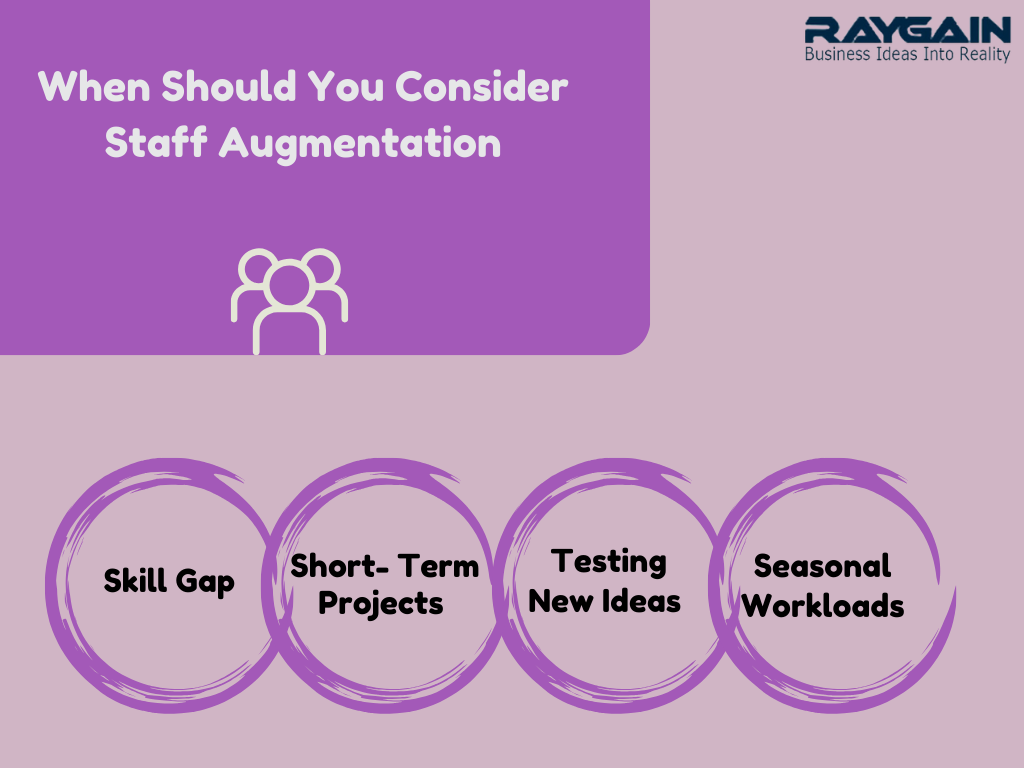
While staff augmentation offers numerous benefits, it may not be the right solution for every situation. Here are some scenarios where staff augmentation is particularly advantageous:
While staff augmentation offers numerous benefits, it may not be the right solution for every situation. Here are some scenarios where staff augmentation is particularly advantageous:
Short-term Projects: If you have a project with a fixed timeline and need extra hands on deck, staff augmentation can provide the necessary resources without long-term commitment.
Skill Gaps: When you need expertise that your current team lacks, bringing in specialists through staff augmentation can bridge the gap and ensure project success.
Seasonal Workloads: For businesses that experience seasonal spikes in demand, staff augmentation can help manage the increased workload without the need for permanent hires.
Testing New Ideas: If you’re launching a new product or service and want to test the waters without a full-scale investment, staff augmentation can provide the temporary talent needed to get the project off the ground.
CONCLUSION
In an era where agility and flexibility are crucial for business success, staff augmentation offers a powerful solution for companies looking to enhance their capabilities without the burden of long-term commitments. By leveraging this strategy, businesses can access specialized skills, scale their workforce quickly, and remain competitive in a dynamic market. It’s a smart, cost-effective approach that allows you to focus on what you do best while leaving the rest to the experts.
OUR LATEST BLOG
- The Rise of AI Chatbot Development Company
- The Future Trends of Data Science and Artificial Intelligence: Shaping Tomorrow’s World
- Staff Augmentation : How It Can Transform Your Business
- How IT Consulting Services Drive Businesses to New Heights
- The Importance of Data Analysis in Today’s Digital World
